CTL/CESL Experiential Learning (EL)
Collaboration Program between
the Centre for Teaching and Learning (CTL) and the Centre for Experiential and Service Learning (CESL)
Collaboration Program between
the Centre for Teaching and Learning (CTL) and the Centre for Experiential and Service Learning (CESL)
Experiential Learning (EL) is a term coined by David A. Kolb as a recursive learning process. Students engage in concrete experiences to construct knowledge and skills through application and problem-solving. The learners’ reflections on their experiences allow them to navigate their learning and to alter their conceptions in line with the learning experiences they have endeavoured. The Association of Experiential Education (AEE) defined EE as “a teaching philosophy that informs many methodologies in which educators purposefully engage with learners in direct experience and focused reflection to increase knowledge, develop skills, clarify values, and develop people’s capacity to contribute to their communities.” Implementing EL varies across disciplines and courses, even within the same discipline. To ensure meaningful EL experiences, they must be constructively aligned with the course learning outcomes, with clear descriptions of experiential objectives and expected learning outcomes that cover both content and processes.
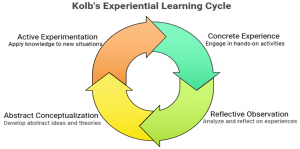
The EL theory developed by Kolb holds that individuals learn from meaningful experiences. Kolb’s four-stage cycle encompasses active student engagement in concrete, hands-on experience, followed by reflection, questioning, and discussion with others. The third stage involves abstract conceptualization, in which students conclude from their experiences, followed by the critical analysis of those experiences. The last stage of Kolb’s cycle, active experimentation, involves transferring the knowledge acquired from experience to new situations. All four stages are crucial for the successful implementation of Experiential Learning.
The Centre for Teaching and Learning (CTL) and the Centre for Experiential and Service Learning (CESL) are partnering to launch a series of Experiential Learning Events starting Winter 2026.
Overview
These events will deepen and broaden our shared understanding of experiential learning (EL). The goal is to clarify its full scope, highlighting how it is already embedded across the University of Regina, and exploring how we can continue to strengthen and expand its impact for students, campus, and community.
• Provide a clear overview of EL, its definitions, and its potential applications.
• Highlight current examples of EL from across diverse faculties and disciplines.
• Demonstrate how EL can enrich teaching, deepen student learning, and align with institutional goals.
• Inform educators about the supports available through CTL, CESL, and the University more broadly.
To ground the conversation in real teaching experiences, the workshop will feature speakers from different subject areas. Each speaker will:
• Share how they have applied EL in their course(s).
• Discuss the type of EL used and how it aligns with course outcomes.
• Describe what students did, what they produced, or how they engaged.
• Present outcomes for both student learning and broader impacts.
• Reflect on what they might change or enhance in future iterations.
Purpose
These events align closely with institutional priorities and ongoing work. Within the 2020-2025 Strategic Plan – All Our Relations – kahkiyaw kiwâhkômâkaninawak, the Universities first goal is “All students will participate in Experiential learning opportunities.”. Throughout the lifetime of this plan, it has become evident that to reach this goal, all typologies of EL must increase. The 2026 and beyond strategic plan is expected to further strengthen the emphasis on EL.
With the support of President Dr. Jeff Keshen, the Centre for Experiential and Service Learning was established in 2022 to support EL across the university. Through ongoing efforts to tag EL-related courses, it was discovered that many instructors already incorporate EL, often without formally identifying it as such.
These events aim to raise awareness, celebrate existing practices, and encourage more educators to embed EL intentionally in their teaching.
Resources
Afida A., Rosadah A. M., Aini H., Mohd Marzuki M. (2012). Creativity enhancement through experiential learning. Adv. Nat. Appl. Sci. 6, 94–99. [Google Scholar]
Association for Experiential Education (AEE) http://www.aee.org/
Boggu A. T., Sundarsingh J. (2019). An experiential learning approach to fostering learner autonomy among Omani students. J. Lang. Teach. Res. 10, 204–214. doi: 10.17507/jltr.1001.23 [DOI] [Google Scholar]
Bradberry L. A., De Maio J. (2019). Learning by doing: The long-term impact of experiential learning programs on student success. J. Political Sci. Educ. 15, 94–111. doi: 10.1080/15512169.2018.1485571 [DOI] [Google Scholar]
Business/Higher Education Roundtable (BHER) (2016). Taking the Pulse of Work-integrated Learning in Canada. Retrieved from http://bher.ca/wp-content/uploads/2016/10/BHER-Academica-report-full.pdf
Upcoming Sessions:
Winter 2026
Section 1– Tuesday, March 10, 1:30-3:00pm, AH 105.6
Section 2– Monday March 30, 2026, 1:30-3:00pm, AH 105.6
Section 1– Wednesday, April 8, 1:30-3:00pm, AH 105.6